Custom AI can absolutely change the economics of a business, but most teams get in trouble when they start with the model instead of the business decision. The real question is not 'how do we add AI?' It is 'which parts of this workflow benefit from machine speed, and which parts still need human judgment?' The companies that answer that well build systems that compound. The ones that do not usually end up with a costly demo, unclear ownership, and a product nobody fully trusts.
Start with the decision, not the dataset
A strong AI initiative begins by identifying a narrow, high-value decision that happens often enough to matter. That might be document classification, lead qualification, drafting recommendations, or surfacing anomalies in operations data. If the job to be done is vague, the eventual model will be vague too.
Before any training or prompt engineering, define the outcome in plain language: what should the system produce, who uses it, and what business action follows. This step usually reveals whether you need a prediction model, a retrieval workflow, a ranking system, or a simpler automation layer wrapped around existing tools.
Audit the data you actually have
Teams often assume they are ready for custom AI because they have a lot of data. Volume helps, but consistency, labeling, permissions, and recency matter more. If records are incomplete, stored across disconnected tools, or shaped by years of ad hoc processes, the best investment may be a data cleanup sprint before any serious model work begins.
This is also where governance enters the picture. You need to know which systems are authoritative, what fields are reliable, what can be used for training, and where privacy or compliance boundaries must be enforced. Getting that clear up front saves expensive rework later.
Build the smallest useful version first
The first production-worthy version of an AI feature should be intentionally modest. It should solve one problem, expose uncertainty clearly, and fit into a workflow your team already understands. Ambitious end states are useful for roadmap planning, but the first release should optimize for observability and learning.
At Orpheus, we use AI-assisted engineering to stand up prototypes quickly, then shift most of the effort toward evaluation, instrumentation, and interface design. That is where trust is won. A fast prototype is easy. A dependable feature that behaves well under real usage is the actual product.
Design human review into the system
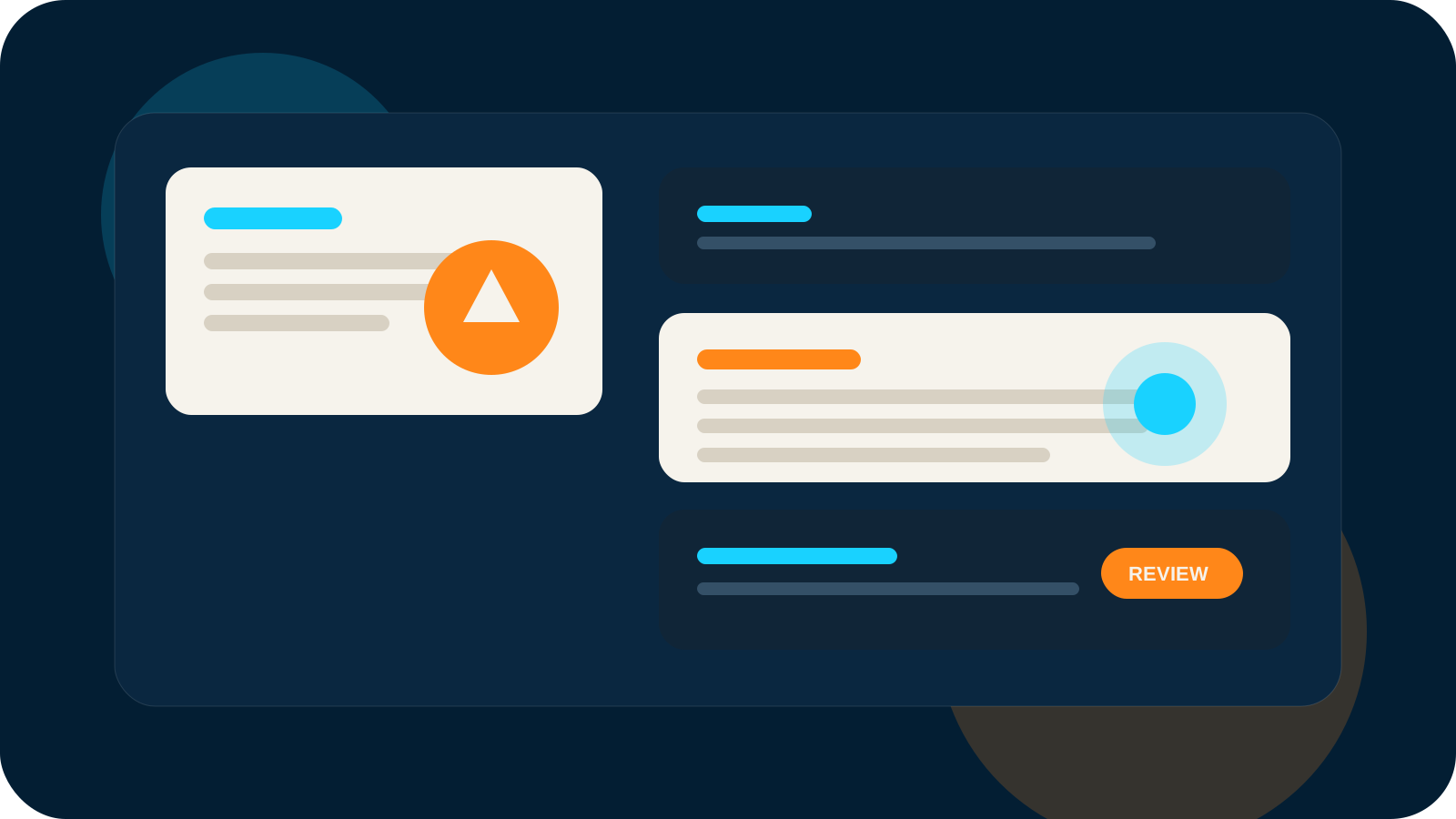
Every business-critical AI workflow needs explicit review paths. That can mean approvals for low-confidence outputs, escalation when the system sees unusual inputs, or a user interface that makes it easy for internal teams to correct results. Human review is not a fallback for failure; it is part of the product architecture.
When people can see why an output was generated, what sources informed it, and how to amend it, adoption rises dramatically. Reviewable systems also create the feedback loop you need to improve performance over time.
Measure quality after launch, not just before it
A launch is the beginning of model operations, not the end of implementation. Once real users interact with the system, you need ongoing metrics for precision, latency, escalation rate, and downstream business impact. Those measurements should be visible to both technical and non-technical stakeholders.
The best custom AI programs treat production as a living environment. They revisit prompts, retraining schedules, thresholds, and interfaces as user behavior changes. That discipline is what turns a one-time feature into an asset that keeps improving.