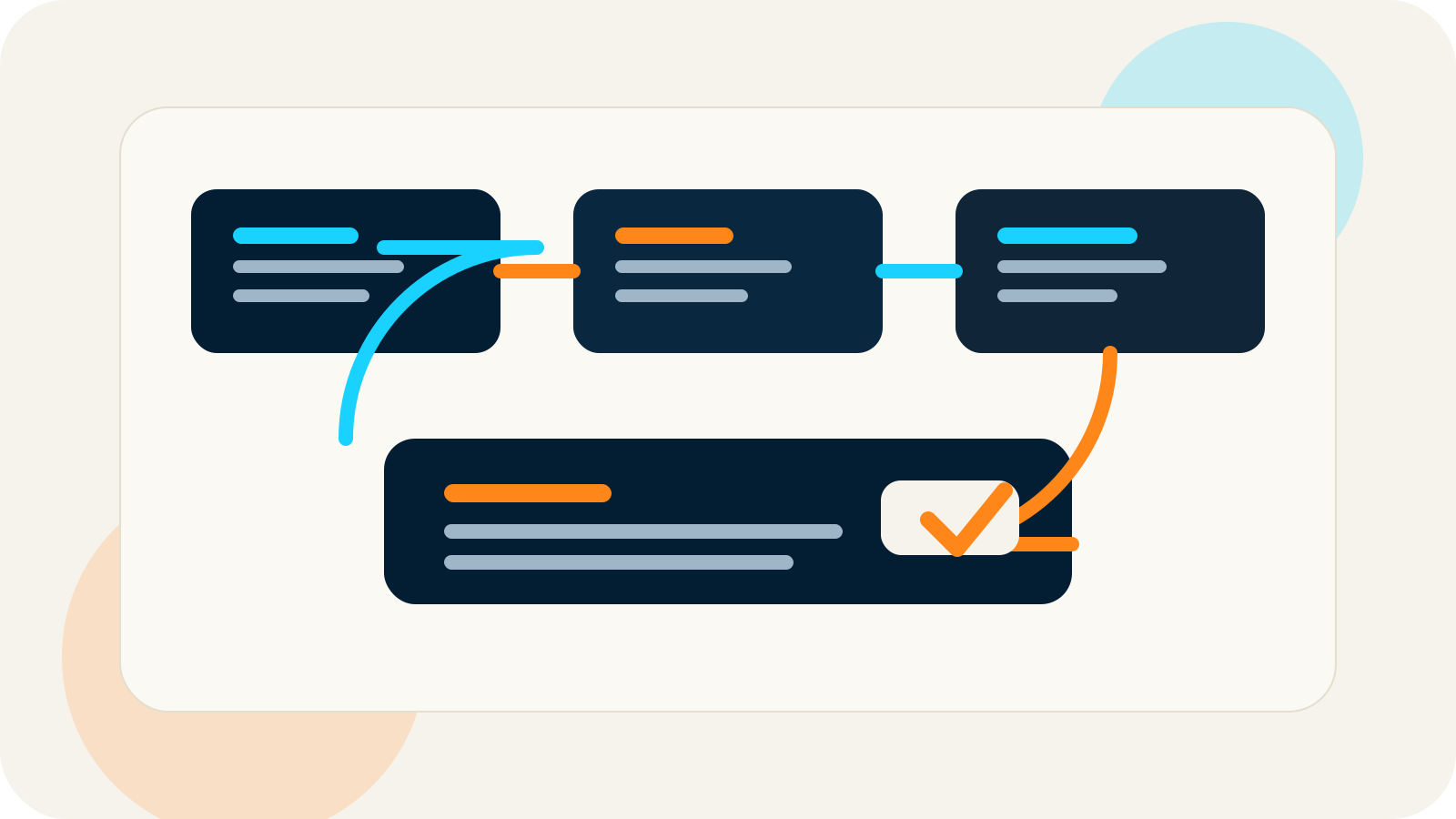
There is a persistent myth in product teams that the most mature AI experience is the one with the fewest people involved. In practice, the opposite is often true. The strongest AI products are not the ones that remove humans from the process entirely. They are the ones that make human judgment visible, efficient, and easy to apply at the moments that matter most.
Automation without accountability breaks quickly
Unchecked AI can generate polished outputs that look credible long before they are truly reliable. That makes failure harder to detect, especially in environments where users are under time pressure and assume the system has already been validated.
If nobody clearly owns review, errors drift downstream into customer service, compliance, operations, or reputation. A human-in-the-loop model protects against that by assigning responsibility for the final decision rather than pretending the system can operate without oversight.
Review gates should be intentional, not improvised
A mature AI feature defines exactly where review happens. That might be before publishing generated content, before approving a recommendation, or only when a confidence threshold is not met. What matters is that the rule is explicit and connected to business risk.
The review step should also be designed to be fast. If a person has to dig through raw logs or reconstruct context from multiple screens, the workflow will not scale. Good product design turns review into a focused task with the right evidence attached.
Human oversight improves the model over time
Every correction a reviewer makes is a learning opportunity. It tells you where the system is overconfident, where source data is weak, and where your interface may be encouraging the wrong behavior. Without those interventions, teams lose the signal that helps them refine prompts, policies, or training data.
This is why review should be instrumented, not hidden. Track what gets corrected, what gets escalated, and what repeatedly confuses the system. The pattern of those edits is often more useful than benchmark metrics alone.
Trust grows when users can see the process
Users do not need a perfect system to trust a product. They need a system whose behavior makes sense. When an interface shows confidence, cites sources, and clearly marks what still needs approval, people understand the role AI is playing and can use it more intelligently.
That transparency is especially important in regulated or high-stakes domains, but it matters in everyday software too. The more clearly a product communicates how decisions are made, the more confidently teams can adopt it.